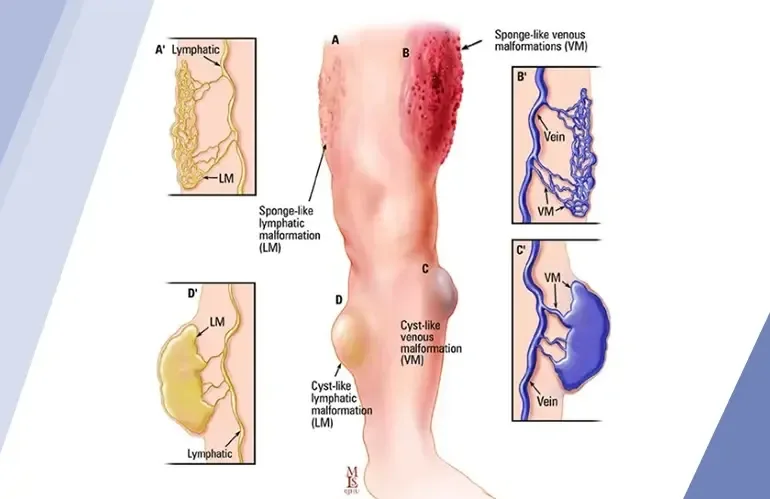
Vascular malformations are uncommon abnormalities involving the development of blood vessels or lymphatic vessels. They can affect different parts of the body and may be present from birth, although some may become more noticeable later in life. Depending on their type, size, location, and blood-flow characteristics, vascular malformations can cause skin discoloration, swelling, pain, bleeding, or problems affecting nearby tissues and organs.
Understanding the different types of vascular malformations, their symptoms, diagnosis, and treatment options can help patients seek appropriate medical care at the right time.
What Are Vascular Malformations?
Vascular malformations occur when blood vessels or lymphatic vessels develop abnormally. Unlike some vascular tumors, vascular malformations are structural abnormalities of the vessels and can remain present throughout a person's life.
They may involve veins, arteries, capillaries, lymphatic vessels, or a combination of these vessels. Some vascular malformations are small and cause few or no symptoms, while others may grow or become symptomatic over time.
The appropriate treatment depends on factors such as the type of malformation, its location, blood-flow pattern, size, symptoms, and whether surrounding structures are affected.
Types of Vascular Malformations
Vascular malformations are broadly classified according to the type of vessel involved.
1. Capillary Malformations
Capillary malformations are abnormalities involving small blood vessels called capillaries. They may appear as flat pink, red, or purple patches on the skin.
Port-wine stains are a well-known example of capillary malformations. Their appearance can become more prominent over time, and the affected area may require specialist evaluation depending on its location and characteristics.
2. Venous Malformations
Venous malformations occur due to abnormal development of veins. They can appear as soft, compressible masses beneath or within the skin and may have a bluish or purple appearance.
Symptoms may become more noticeable when the affected area is dependent, during physical activity, or after prolonged standing. Some patients may experience pain, swelling, or discomfort.
3. Arteriovenous Malformations (AVMs)
Arteriovenous malformations, commonly called AVMs, involve abnormal connections between arteries and veins.
Normally, blood flows from arteries through smaller vessels before reaching the veins. In an AVM, abnormal connections allow blood to flow directly from arteries into veins. This can result in high-flow circulation through the malformation.
Depending on its location and size, an AVM may cause swelling, pain, skin changes, bleeding, or complications involving nearby tissues.
4. Lymphatic Malformations
Lymphatic malformations involve abnormal development of lymphatic vessels. They may form fluid-filled cystic spaces and can occur in different parts of the body.
They may present as swelling or a soft mass and can sometimes become more noticeable following infection, trauma, or other inflammatory conditions.
What Causes Vascular Malformations?
Vascular malformations generally result from abnormalities in the development of blood vessels or lymphatic vessels.
Many are believed to result from changes that occur during vascular development before birth. In some cases, genetic or molecular changes may contribute to the abnormal development of the vessels.
Lifestyle choices do not necessarily cause vascular malformations. However, certain factors such as trauma, infection, hormonal changes, or other conditions may cause an existing malformation to become more noticeable or symptomatic.
Symptoms of Vascular Malformations
Symptoms can vary significantly depending on the type, location, size, and blood-flow characteristics of the vascular malformation.
Common symptoms may include:
- Pink, red, blue, or purple skin discoloration
- Swelling or enlargement of the affected area
- A soft or compressible mass beneath the skin
- Pain or discomfort
- A feeling of heaviness in the affected limb
- Swelling that becomes worse with activity or prolonged standing
- Bleeding in certain types of vascular malformations
- Recurrent inflammation or infection
- Difficulty moving a nearby joint
- Compression of nearby nerves, muscles, or organs
- Functional problems depending on the location of the malformation
Some vascular malformations may remain asymptomatic for years. However, new or worsening symptoms should be evaluated by an appropriate specialist.
How Are Vascular Malformations Diagnosed?
Accurate diagnosis is important because different vascular malformations can require different treatment approaches.
A vascular specialist may begin with a detailed medical history and physical examination. Depending on the suspected type and location, imaging investigations may be recommended.
Diagnostic tests can include:
Doppler Ultrasound
Doppler ultrasound can help assess blood flow within vessels and determine whether a lesion has low-flow or high-flow characteristics.
MRI
Magnetic resonance imaging can provide detailed information about the size, depth, and relationship of a vascular malformation with surrounding muscles, nerves, organs, and other structures.
CT Imaging
In selected cases, CT imaging may help evaluate deeper or complex vascular abnormalities.
Angiography
Angiography may be used in selected high-flow vascular malformations, particularly when detailed information about the feeding arteries and draining veins is required for treatment planning.
The choice of investigation depends on the suspected vascular abnormality and the patient's individual clinical situation.
Treatment Options for Vascular Malformations
Not every vascular malformation requires immediate treatment. The treatment approach is individualized according to symptoms, location, size, type, blood-flow pattern, and potential complications.
1. Observation
Small vascular malformations that do not cause symptoms may sometimes be monitored without immediate intervention.
Regular clinical follow-up may be recommended to assess whether the lesion changes or develops symptoms.
2. Medications
Certain medications may be considered in specific vascular malformations or situations.
Medication selection depends on the type of vascular abnormality, the patient's age and medical condition, and the treatment objective. Medication should only be used under appropriate specialist supervision.
3. Sclerotherapy
Sclerotherapy is a minimally invasive treatment that may be used for selected vascular malformations, particularly certain low-flow venous or lymphatic lesions.
During the procedure, a sclerosing agent is injected into the abnormal vessels. The treatment causes the targeted spaces to close or shrink, helping reduce the size of the malformation and associated symptoms.
Multiple treatment sessions may sometimes be required depending on the size and characteristics of the lesion.
4. Embolization
Embolization is a minimally invasive procedure used for selected vascular malformations.
A specialist introduces a catheter into the blood vessels and delivers an embolic material to reduce or block abnormal blood flow.
For certain high-flow lesions such as AVMs, embolization may be performed to control abnormal blood flow and reduce the risk of complications. It may also be used before surgery in selected cases.
5. Surgical Excision
Surgical removal may be considered for selected vascular malformations, particularly when the lesion is localized and can be removed safely.
However, complete removal may not always be possible, especially when a malformation extends into deeper tissues or involves important structures. In such cases, treatment may require a combination of approaches.
The risk of recurrence can depend on the type, location, depth, and completeness of treatment.
Can Vascular Malformations Come Back?
The possibility of recurrence depends on the type and extent of the vascular malformation and the treatment performed.
Some malformations can extend into surrounding tissues, making complete removal difficult. Residual abnormal vessels may result in persistence or recurrence of symptoms.
For this reason, long-term follow-up may be recommended for patients with complex vascular malformations.
When Should You See a Vascular Specialist?
You should consider specialist evaluation if you notice:
- Unexplained swelling or enlargement of a body part
- Persistent skin discoloration
- A soft or compressible lump
- Recurrent pain or swelling
- Unexplained bleeding
- A vascular lesion that appears to be increasing in size
- Symptoms affecting movement or function
- A previously diagnosed vascular malformation that has become painful or swollen
Early assessment can help identify the type of vascular abnormality and determine whether observation, imaging, minimally invasive treatment, surgery, or a combination of approaches may be appropriate.
Vascular Malformation Treatment in Hyderabad
Patients with suspected or diagnosed vascular malformations may benefit from evaluation by a multidisciplinary vascular team.
At One Stop Vascular Solutions in Hyderabad, patients can receive evaluation and treatment planning for a range of vascular conditions. Depending on the patient's condition, management may involve vascular surgeons, interventional specialists, and other relevant medical professionals.
Treatment options may include minimally invasive procedures such as sclerotherapy or embolization, as well as surgical treatment when clinically appropriate.
The right treatment depends on the individual patient's diagnosis and should be determined following a proper clinical evaluation and appropriate imaging.
Conclusion
Vascular malformations are complex abnormalities that can affect blood vessels or lymphatic vessels in different parts of the body. Their symptoms and severity can vary widely, ranging from mild skin discoloration to swelling, pain, bleeding, or functional problems. Understanding the type of vascular malformation is an important first step toward choosing the appropriate management. Depending on the condition, treatment may include observation, medication, sclerotherapy, embolization, surgical excision, or a combination of approaches.
Get Expert Care for Vascular Malformations in Hyderabad
The team at One Stop Vascular Solutions in Hyderabad provides comprehensive evaluation and personalized treatment planning for various vascular conditions, including vascular malformations, with expert, patient-focused care.
Book an Appointment with One Stop Vascular Solutions today and get expert guidance for your vascular health.